Dividing matrimonial property
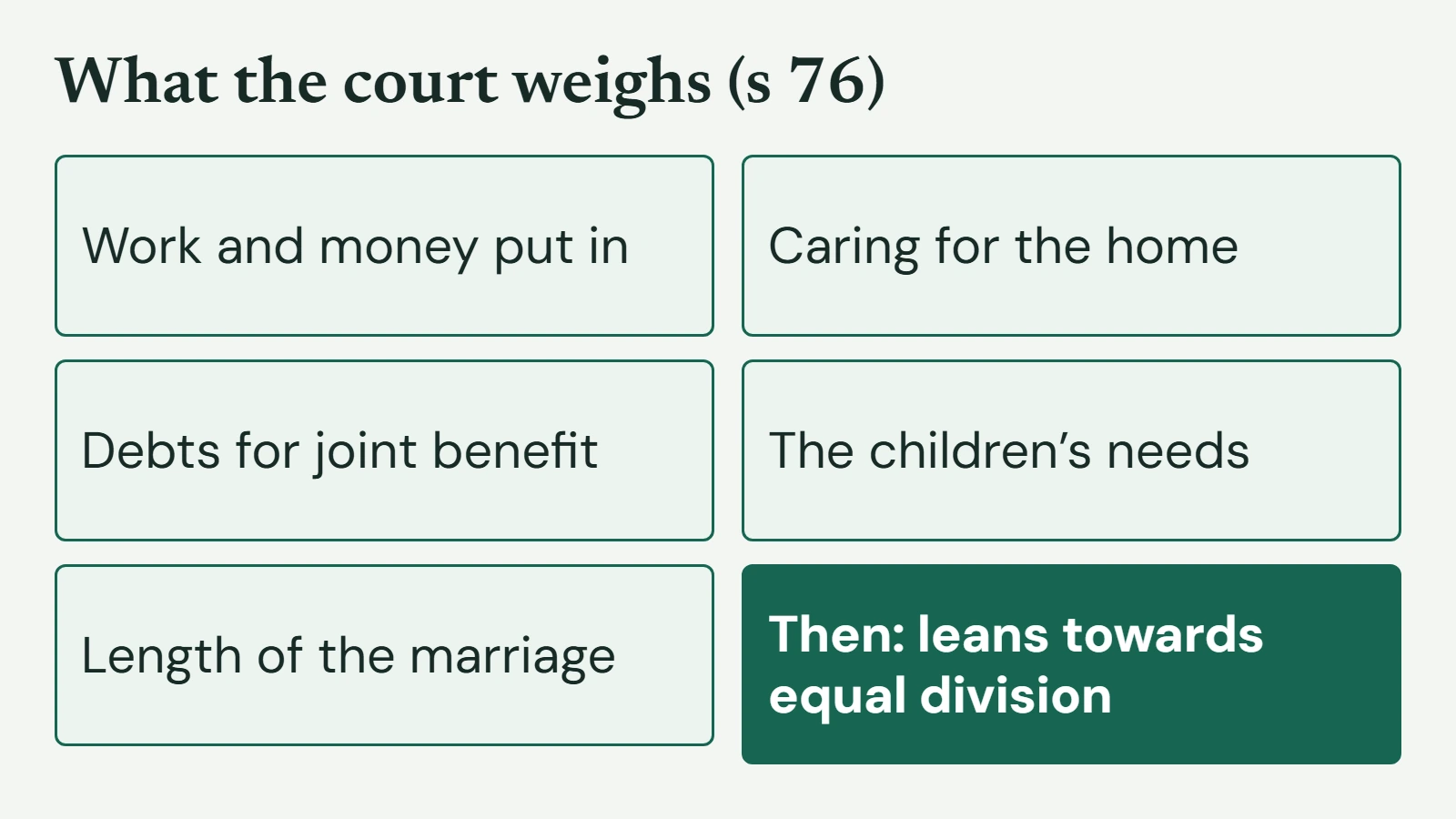
Under section 76 of Act 164 the court can divide assets the couple acquired during the marriage by their joint efforts. It weighs each spouse's contributions, including looking after the home, joint debts, the children's needs and the length of the marriage, and inclines towards equality.
What counts as matrimonial property in a Malaysian divorce, and how does the court divide it?
Section titled “What counts as matrimonial property in a Malaysian divorce, and how does the court divide it?”For non-Muslim couples, the power to divide assets sits in section 76 of the Law Reform (Marriage and Divorce) Act 1976 (Act 164). “Matrimonial property” is the everyday phrase. The Act itself talks about assets.
Section 76(1) says that when the court grants a decree of divorce or judicial separation, it may order the division between the parties of any assets acquired by them during the marriage by their joint efforts. It can also order the sale of those assets and the division of the proceeds.
Section 76(5) widens this. Assets owned by one spouse before the marriage count as acquired during the marriage if the other spouse, or both of them together, substantially improved them during the marriage.
Section 76(2) lists what the court must have regard to:
- the contributions each spouse made in money, property or work towards acquiring the assets, or towards paying expenses for the benefit of the family (section 76(2)(a));
- the contributions of the spouse who did not acquire the assets, by looking after the home or caring for the family (section 76(2)(aa));
- any debts either spouse took on for their joint benefit (section 76(2)(b));
- the needs of the minor children of the marriage (section 76(2)(c));
- how long the marriage lasted (section 76(2)(d)).
Subject to those points, section 76(2) says the court “shall incline towards equality of division”.
Is the division always 50/50?
Section titled “Is the division always 50/50?”No. “Incline towards equality” is a starting lean, not a fixed split. The Act gives no scale or percentage.
Yong Jin Man, a divorce lawyer, says there is a common belief that the split must be 50/50, but there is “no scale”. These are his practice notes, not the law. In his experience:
- In a joint petition, where both spouses agree to the divorce, the couple settle the split between themselves. See joint or contested divorce.
- In a contested (single petition) case, a spouse can ask for a very large share, and he says asking for most of the assets is not unusual. Whether the court agrees is a separate question.
- The court tests the request against what the spouse actually needs, whether they gave up a career to look after the children, how long the marriage was, how much they spend, and what each side contributed in money, time and effort.
- A spouse who stayed at home has contributed. He says this applies to a wife or a husband.
That matches the Act. Section 76(2)(aa) names looking after the home or caring for the family as a contribution that the court must weigh, whichever spouse did it.
What about assets in one spouse’s name, or inherited and gifted property?
Section titled “What about assets in one spouse’s name, or inherited and gifted property?”What the Act says. Section 76 does not mention whose name is on the title. It looks at how an asset was acquired and what each spouse contributed. Section 76(1) speaks of assets acquired “by their joint efforts”. Subsections (3) and (4) of section 76, which dealt separately with assets acquired by one spouse’s sole effort, are shown in the official text as deleted by Act A1546, so this page cannot quote a sole-effort rule from the Act. Courts have been asked what that change means. A July 2026 High Court summary lists the question “whether assets acquired by sole effort remain divisible after 2017 amendments” (see the decisions below). Ask a lawyer how it is applied to your assets.
Section 76(5) covers property owned before the marriage. It counts as acquired during the marriage if the other spouse, or both together, substantially improved it during the marriage.
What Yong says. In his experience, property one spouse inherited, for example land from a grandparent, stays outside the pool of matrimonial assets. The other spouse cannot take a share of it. The exception he describes is where the other spouse worked on it or improved it. In his words, the spouse can claim “unless he’s worked on it”. If the other spouse did nothing, he says, they cannot claim a share.
Those are two separate things. The first is the Act. The second is his practical experience of how it plays out. Keep your own records of any work you did on a property that is not yours on paper, such as payments, receipts and photographs.
What if my spouse moves assets away?
Section titled “What if my spouse moves assets away?”Section 102 of the Act deals with this. It applies where, among other situations, a matrimonial proceeding is pending, or an order under section 76 has not been complied with. On application, the court can:
- set aside a disposition if it is satisfied that a spouse made it within the preceding three years, with the object of reducing their means to pay maintenance or of depriving the other spouse of rights in that property (section 102(1)(i)); and
- grant an injunction to stop a disposition that is intended to be made with that object (section 102(1)(ii)).
“Disposition” includes a sale, gift, lease, mortgage or any other transaction that transfers or burdens ownership or possession. “Property” includes money (section 102(2)). A disposition made for money’s worth to someone who acted in good faith and did not know the object is not caught.
In the interview, Yong put the realistic look-back at about two years, while saying he could not remember whether it was two or three. Section 102 says three years. Go by the Act’s three years, and ask a lawyer to check the dates for your case.
His practical point is that the court can look at how a person actually lives. A spouse who says there is no money, but keeps changing cars or spends freely, gives the other side evidence. If a spouse says an asset was a gift from someone, he says that person should be ready with the receipts and paperwork, because the judge can ask a lot of questions. Our alimony and maintenance guide covers support claims, which section 102 also protects.
A case Yong describes
Section titled “A case Yong describes”Yong describes a case from memory. It has no case number here, and the figures below are his recollection, not a checked record.
He says the marriage lasted almost 30 years. The wife was a foreigner who did not work and had lived at a high standard throughout. The couple had no matrimonial home, as they rented. As he recalls, the court did not give her property. It awarded her a large sum of cash, which he remembers as roughly 40 to 50 per cent, because she was going back to her own country and the court took into account the standard of living she was used to.
What it shows, in his account, is that a long marriage and a non-earning spouse can still lead to a large award, and that the court can choose cash over property when there is no home to divide.
Winning an award is not the same as receiving it. A share ordered by the court does not arrive immediately. Property may have to be valued, sold or transferred first, and an order that is not paid has to be enforced. Plan for that gap when you decide what to ask for.
Do prenuptial or postnuptial agreements decide the split?
Section titled “Do prenuptial or postnuptial agreements decide the split?”Not on their own. Yong says the law on prenuptial agreements (signed before marriage) is not settled, and that they are not really enforceable in the way many people assume. A postnuptial agreement is the same kind of contract, signed after the marriage. A court can look at an agreement as evidence of what the couple agreed, but it is not an automatic stamp.
A Court of Appeal report shows the same caution: an arrangement tied to a withdrawn petition was not enforced. See agreements between spouses are not always binding. If a settlement matters to you, ask for it to be written into the court order.
From practice: what Yong Jin Man sees
Section titled “From practice: what Yong Jin Man sees”Yong Jin Man advises building an asset schedule before any negotiation. His checklist:
- property, bank accounts, investments and businesses
- debts and guarantees
- acquisition dates and ownership documents
- financial and non-financial contributions
- improvements made to assets owned before the marriage
- the children’s needs and household spending
He gives two warnings. First, do not assume every asset will be split equally; the court looks at the facts (section 76). Second, do not transfer, hide or dispose of assets to defeat a claim; the court can set such dispositions aside, as the section on a spouse who moves assets away above explains (section 102). He also suggests that engaged couples write down what each of them owns. That is practical advice, not a legal duty to disclose before marriage.
A worked example
Section titled “A worked example”This example is made up to show how the rules apply. It is not a real case.
Mei and Daniel have been married 18 years and have two children under 18. Mei stopped work to look after the family. Daniel earned the income. The family home was bought during the marriage in Daniel’s name. They cannot agree on the split.
- The home was acquired during the marriage. The name on the title does not decide the matter. Section 76(1) lets the court order its division, or its sale and division of the proceeds.
- The court counts Daniel’s contribution in money and Mei’s contribution by looking after the home and the children (section 76(2)(a) and (aa)).
- It also looks at the renovation loan they took on together (section 76(2)(b)), the children’s needs (section 76(2)(c)) and the 18-year length of the marriage (section 76(2)(d)).
- Subject to those points, the court inclines towards equality of division (section 76(2)).
- Daniel also owns a flat bought before the marriage. If Mei substantially improved it during the marriage, it counts as acquired during the marriage (section 76(5)). If she did not, it does not count.
- After the divorce papers are filed, Daniel moves his savings to his brother. If the court is satisfied he did this within the preceding three years to deprive Mei of her rights in that property, it can set the transfer aside, or stop one that is about to happen (section 102(1)). It cannot do so against someone who paid value in good faith without knowing the object.
Sources
Section titled “Sources”- Law Reform (Marriage and Divorce) Act 1976 (Act 164), official text, Attorney General’s Chambers. Sections 76 and 102 read from this text.
- eJudgment portal.
What recent decisions show
| Date | Subject | Outcome |
|---|---|---|
| — | Dismissed with costs in its entirety: no material change in circumstances, and the consent order is final and binding. | |
| — | Joint guardianship to both parents; sole custody, care and control to the wife; reasonable access to the husband; child maintenance of RM1,800 per child per month; the husband shares education and healthcare costs; an injunction under section 103; costs to the wife. | |
| — | The court found she had not proved a material change in circumstances, so there was no basis to disturb the existing shared custody arrangement. | |
| — | Allowed: shared guardianship, with sole custody, care and control to the wife; the husband has unsupervised reasonable access in Australia and Malaysia and must consent to the child relocating to Australia. | |
| — | The court allowed the husband's discovery application only in part: the wife must produce, within 14 days, the financial statements of two companies where she is a shareholder or director and the monthly rental statements of two named properties. The rest of his 14 categories of requests (payslips, bank statements, tax returns, foreign assets and so on) were refused as too wide, irrelevant or a fishing expedition. The husband must pay the wife costs of RM3,000 (subject to allocator fees) within 14 days. |